Every year, Indians undergo close to a billion diagnostic tests. We treat the result as gospel. We start medication because of it, change our diet for it, and sometimes make life-altering decisions on a single printed number. Yet almost none of us ever ask the most basic question about that number: what actually happened to our blood between the moment it left our body and the moment it became a report?
The answer, for most people, is uncomfortable. And it matters far more than we realise.
The invisible phase where things go wrong
Laboratory testing happens in three phases: pre-analytical (collection, handling, transport), analytical (the actual testing), and post-analytical (reporting). Most of us assume errors, if they happen at all, occur inside the machine.
The data says the opposite. Across numerous peer-reviewed studies, the pre-analytical phase, everything that happens before your sample reaches the analyser, accounts for an estimated 46% to 68% of all laboratory errors. The analytical phase, the part we worry about, contributes only around 7% to 13%.
In plain terms: the riskiest moment for your blood test isn't the test itself. It's the journey. One large study of over 231,000 samples found the single most common reason for rejection was storage issues due to transportation delay. Other hospital studies have documented pre-analytical error rates of 9% to over 12% of all samples, highest in the emergency department, where speed matters most.
Why time is the enemy
Blood is a living tissue, and it begins to change the instant it leaves your body. Different tests have very different tolerances, and most patients are never told this. As a rough guide to how quickly a sample should ideally reach the lab after collection:
- Arterial blood gas (ABG), lactate, ammonia: minutes. The most fragile; values can drift almost immediately if delayed or not kept cold.
- Serum electrolytes (sodium, potassium), glucose: ideally within about 30 minutes to an hour, before the numbers begin to shift.
- CBC (complete blood count): best processed within a few hours; cell counts and morphology change on standing.
- LFT, RFT/KFT, thyroid and lipid profiles: more forgiving, but still best handled within a few hours under proper storage.
When a sample degrades, one of two things happens. Either the lab notices and rejects it, meaning you get pricked again and your diagnosis is delayed. Or, worse, the lab doesn't notice, and you receive a result that looks normal on paper but no longer reflects your actual health. A slightly haemolysed sample can falsely elevate potassium. A delayed glucose sample can read lower than reality. You would never know. Neither would your doctor.
The destination matters as much as the journey
A sample handled perfectly still has to arrive somewhere trustworthy. Yet India's roughly 100,000-plus diagnostic laboratories vary enormously in quality, and only a small fraction hold NABL accreditation; the certification that verifies a lab actually follows international standards for how samples are handled and tested. Many patients never find out which lab their sample reaches, or whether that specific lab is accredited for that specific test. The journey and the destination are part of the same chain of trust, and both are usually invisible to the person whose blood it is.
The questions you should actually be asking
None of this means you should stop getting tested. An estimated 60% to 70% of all clinical decisions are based on lab results. It means you should become a more informed patient. Before your next test, it is entirely reasonable to ask: Who is collecting my sample, and are they trained and accountable? How quickly will it reach the lab, and how is it kept stable in transit? Which lab is processing it, and is that lab NABL-accredited for this test? If my result looks abnormal, can I have it re-verified before acting on it?
A responsible diagnostic provider should be able to answer every one of these without hesitation. If they can't, that itself is information.
Making the journey visible
This is the problem a new generation of health platforms is beginning to take seriously, treating the sample's journey as something to be engineered and made visible, rather than left to chance.
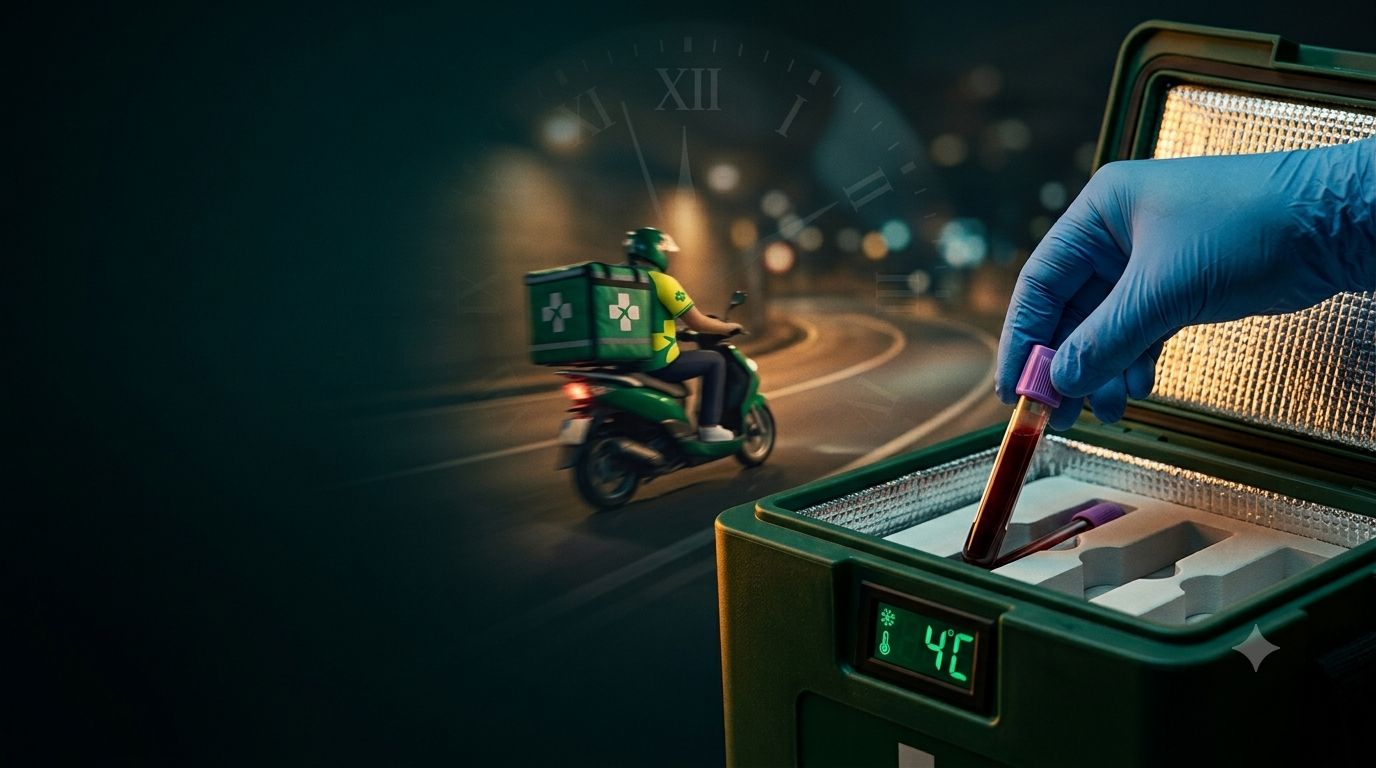
At Zet Health, the platform I co-founded, we built the entire model around one insight: in diagnostics, the last mile decides the truth. We collect samples at home in around 10 minutes, but more importantly, we make sure every sample reaches the lab within the next 30 minutes. That single discipline protects even the most time-sensitive tests.
The rest is transparency. You can see who is collecting your sample: their background, qualifications, and ratings from other patients. You can track your sample live, the way you track a food delivery: which temperature-controlled box it's in, when it's picked up, and the exact time it's handed over at the lab. And if a result ever looks off, we offer a free re-verification, because peace of mind shouldn't be a paid upgrade.
We didn't build this because it's easy. We built it because the current system quietly normalised delay and opacity, and in health, both have consequences.
The next time you give a blood sample, remember that the number you receive is only as trustworthy as the journey it took to get there. You have every right to ask about that journey, and increasingly, the right to expect a provider who has already thought about it, so that when every minute matters, someone shows up who treats your sample the way they'd treat their own family's.
Ashutossh Daash is the Co-Founder and CEO of Zet Health, a speed-led home diagnostics platform.