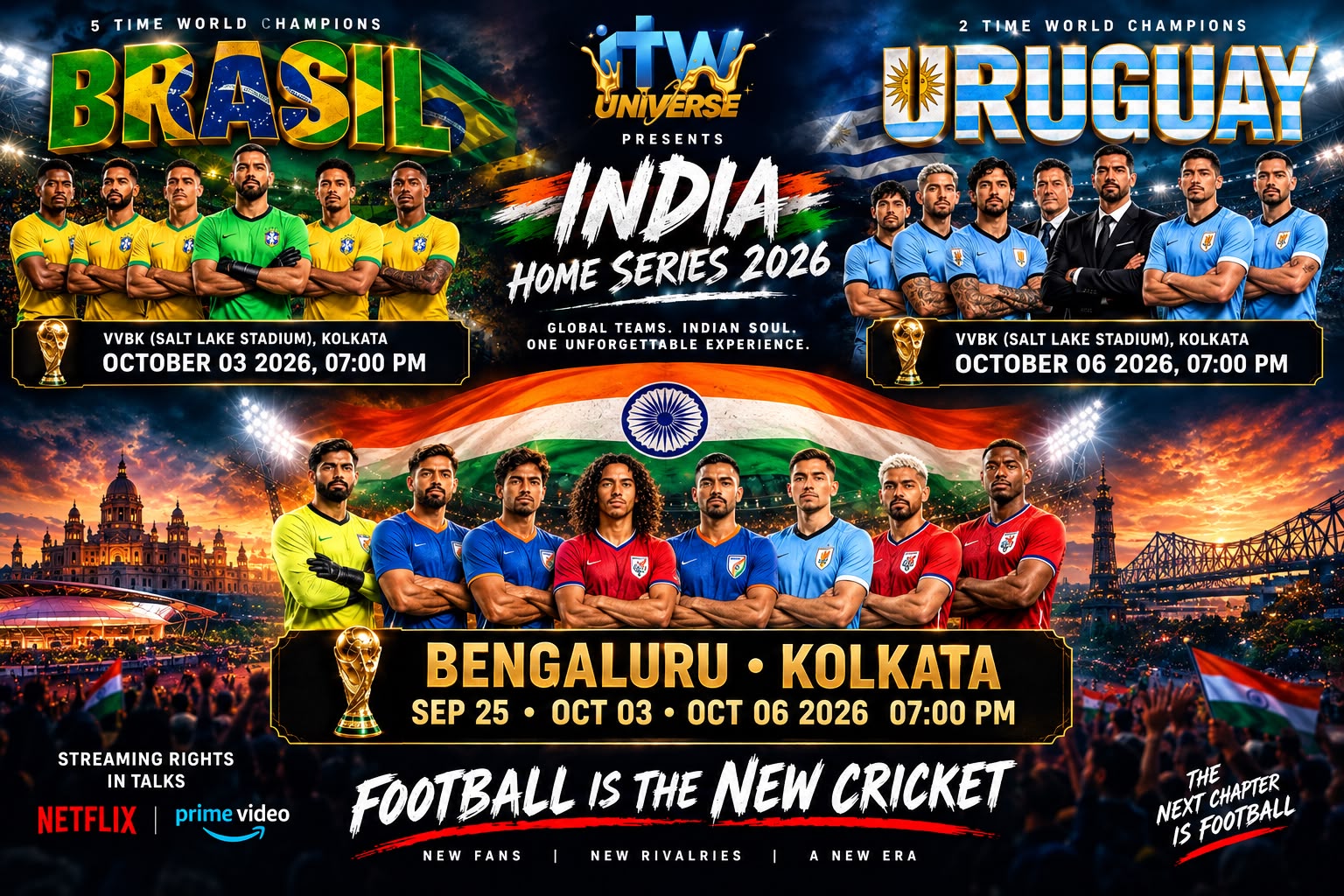
As Brazil, Uruguay and Panama arrive for the India Home Series 2026, Bhairav Shanth and ITW Universe are betting on a powerful cultural shift: football is no longer waiting outside India’s sporting mainstream.
THE ANNOUNCEMENT IS BIGGER THAN A FIXTURE LIST
The visual campaign itself feels less like a conventional sports announcement and more like a cinematic declaration.
1.Brazil.
2.Uruguay.
3.Panama.
4.India.
Three international opponents. Three cities/dates. One unmistakable message — India wants football to become an experience.
The announced Home Series features Panama in Bengaluru on September 25, Brazil in Kolkata on October 3, and Uruguay in Kolkata on October 6, 2026, turning September and October into a potential football spectacle for Indian audiences.
And then there is Brazil.
Five-time world champions.
The yellow shirt. The samba. The history. The mythology.
Opposite them: an India that increasingly wants to see its own football story evolve from participation to aspiration.
That is where the ITW Universe perspective becomes particularly interesting.
Because this isn’t merely about 90 minutes on a pitch.
Adding another layer of intrigue to the Home Series is the streaming conversation. Netflix and Amazon Prime Video are reportedly in talks for the streaming rights, a development that could take the series far beyond the traditional stadium audience and place these high-profile fixtures directly in front of India’s rapidly expanding digital sports audience.
It is about creating cultural electricity around the game.
FOOTBALL ISN'T KNOCKING ANYMORE. IT'S WALKING IN.
For decades, cricket has occupied India's sporting throne.
And deservedly so.
But every throne eventually faces competition.
Across India's metros, college campuses, gyms, cafés, creator communities and social feeds, football has become increasingly embedded in youth culture. The sport is visually explosive, globally connected and naturally built for short-form content, fandom, fashion, music and identity.
Football doesn't just ask you to watch.
It asks you to choose a side.
- Brazil or Argentina.
- Club or club.
- Player or player.
- Attack or defence.
And perhaps that's why the conversation around cricket being "boring" has started appearing in some corners of India's younger audience.
Not because cricket has suddenly become irrelevant.
But because attention itself has changed.
The modern Indian sports consumer wants speed. Drama. Personalities. Rivalries. Atmosphere. Global access.
Football delivers all of it at once.
A match can explode in 30 seconds.
A player can become a global icon overnight.
A goal can become a meme, a reel, a soundtrack and a memory before the final whistle.
That is a different kind of sporting currency.
THE ITW UNIVERSE BET: DON'T JUST STAGE MATCHES. BUILD MOMENTS.
This is where the philosophy around ITW Universe and Bhairav Shanth becomes compelling.
The opportunity isn't simply to put international teams on an Indian football pitch.
The opportunity is to turn every touchpoint into an event that lives beyond the stadium.
The stadium is only the beginning.
The real game is happening across Instagram feeds, creator communities, fan pages, WhatsApp groups, reaction videos, podcasts, digital publications and conversations between friends.
Imagine a generation that doesn't merely watch Brazil arrive in India but experiences Brazil arriving in India.
- The shirts.
- The chants.
- The fan zones.
- The creators.
- The music.
- The content.
- The anticipation.
- The photographs.
- The rivalries.
- The debates.
- The post-match explosions across social media.
That is how a sporting fixture becomes a cultural property.
And that is precisely where the phrase "Into the Wild" from the campaign feels particularly appropriate.
Because Indian football isn't trying to quietly enter the room.
It is preparing to kick the door open.
AND THEN COMES THE INFLUENCER BLAST
The third layer could be the most powerful: turning the announcement into a nationwide conversation.
Football creators, lifestyle influencers, athletes, entertainers, celebrities and digital communities can transform the Home Series from an announcement into a movement.
The question isn't simply:
"Are you watching India vs Brazil?"
It is:
"Where will you be when India faces Brazil?"
That single question can create thousands of stories.
- Reaction videos.
- Prediction wars.
- Dream XIs.
- Brazil vs India debates.
- Football fashion.
- Stadium vlogs.
- Creator watch parties.
- Fan challenges.
"Football is the new Cricket" conversations.
And perhaps the most interesting content of all:
What does India's football future actually look like?
Because once influencers begin talking, the fixture stops belonging only to football fans.
It enters popular culture.
THE NEXT SPORTING REVOLUTION MAY ALREADY HAVE STARTED
Cricket isn't disappearing.
It doesn't need to.
India can love cricket and still fall harder for football.
But what is changing is the space football occupies in the Indian imagination.
The Home Series 2026 could therefore represent something bigger than three international fixtures.
It could become a statement of intent.
A statement that India's football audience is ready for world-class encounters.
A statement that global football can create Indian cultural moments.
And a statement from an ecosystem like ITW Universe that understands one fundamental truth:
In modern entertainment, you don't win attention by announcing an event. You win it by creating something people desperately want to be part of.
Brazil in Kolkata.
Uruguay in Kolkata.
Panama in Bengaluru.
India under the lights.
And an audience waiting to roar.
Maybe the question is no longer whether football can become the new cricket in India.
Maybe the real question is:
How loud will India get when football finally takes centre stage?